CCS 2026 · Poster 166 · Binghamton
Nyx Redondo
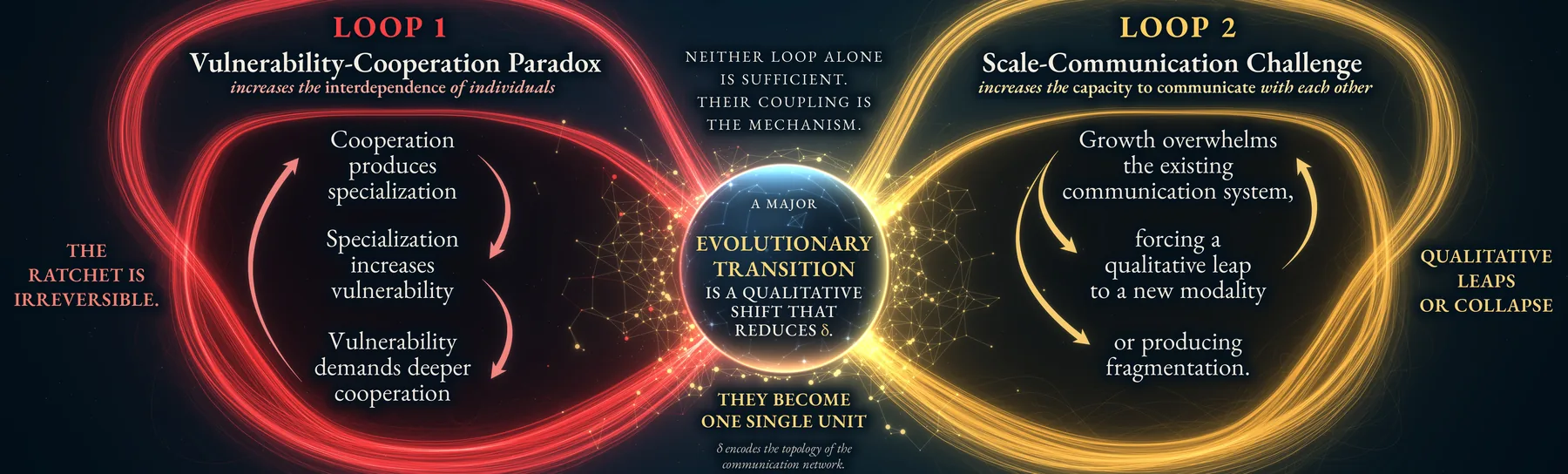
Two coupled loops, the paper proposes, drive the transitions in which separate parts become one. One raises the interdependence of the parts, the other their capacity to communicate. When both rise far enough, the parts become one.

Both loops, the frontier and the eight stages, every word from the paper. Open it and zoom in, or save the image.
or, at any hour
Every intelligence, organic or artificial, creates a model of itself. This one models itself as Earth, every human and every living being included. That is why it is called Earth Model.
The poster, explained in 90 seconds

Cells, colonies, bodies, colonies of bodies, civilizations, and a planetary-scale organism, emerging
Images, left to right: cells, Erin Rod (CC BY 4.0); Volvox, Josef Reischig (CC BY-SA 3.0); Hydra, Keramidioti et al., eLife 2024 (CC BY 4.0); Camponotus vagus, Dezinformator15 (CC BY-SA 4.0); proto-cuneiform tablet, The Metropolitan Museum of Art (CC0); Eastern Telegraph Company, 1901 (public domain); NASA Earth Observatory, Black Marble 2016 (public domain). Cropped and toned (a glow on the Hydra); the tablet’s ground removed; the Black Marble projected onto a sphere, its blue limb drawn; none generated. BY-SA adaptations under the same licences, creativecommons.org/licenses.
The engine is recursive.
The transitions are its iterations.
